Shouldn’t schools approach the use of space differently? What happens when schools “rethink” the use of space – shifting from traditional approaches to participatory spaces?
As noted in previous posts – here and here, schools are rethinking the use of space. Digital Strategist and Designer David Jakes, in his post Towards a Consideration of Space, wrote:
I’m wondering why the spaces that students inhabit for learning haven’t received more attention in the conversation surrounding 1:1 implementations. Can you really have a 1:1 implementation without asking questions of what learning spaces should now become? Can you afford to miss the potential catalyst that 1:1 computing can be for rethinking spaces? Are you satisfied by placing that capacity into a classroom that has a decades old collection and arrangement of furniture and space?
Can you afford to miss the potential catalyst that 1:1 computing can be for rethinking spaces?
– David Jakes
Jakes’ observation is supported by UNC Charlotte’s The Center for Teaching and Learning in Collaborative Learning Spaces, in which the following is noted:
Research shows that student learning styles have changed, therefore we need learning spaces to accommodate a new generation who:
• Prefer multitasking and quick, non linear access to information information,
• Are visually‐ oriented,
• Are highly networked, interactive and social,
• Are increasingly mobile,
• Have a low tolerance for lecture style teaching,
• Prefer active learning rather than passive learning, and
• Rely heavily on communications technologies to access information and to carry out social and professional interactions.
To meet the principles of contemporary learning, new and refurbished spaces need to be:
• Flexible,
• Connected,
• Collaborative,
• Multisensory, and
• Graphic.
• The new spaces need to be a blend of physical and virtual environments.
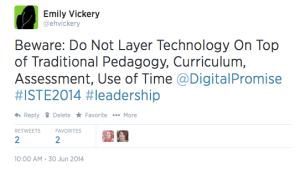
As Jakes noted, “Can you afford to miss the potential catalyst that 1:1 computing can be for rethinking spaces?” Shouldn’t 1:1 schools consider The Center for Teaching and Learning’s research? 1:1 schools are provided the opportunity to rethink space so as not to layer technology on top of traditional pedagogy, curriculum, assessment, and use of time.
Redesigned spaces can quickly be rearranged to suit various collaborative and instructional scenarios that meet contemporary student learning styles.
Shekou International School did just that. Watch the video of their journey in creating participatory learning spaces. (You can follow them at hashtag #SISrocks.)
While resources to assist you in “rethinking” space for relevant learning are growing, including how to undertake your redesign on a shoestring budget, here are a few to get you started:
- THE Journal – Bringing Down the Wall “Schools are using configurable chairs, whiteboards, and even walls to give students control of their environment and inspire them to work together.”
- David Jakes – Classroom Redesign: Strategies for Rethinking Learning Spaces
- The Third Teacher: 79 Ways You Can Use Design to Transform Teaching and Learning
- The Third Teacher Presentation – Hack Class: Shape Your Ecology, Empower Learning (handouts available)
- Make Space: How to Set the Stage for Creative Collaboration
- Teaching the Digital Generation: No More Cookie Cutter High Schools “The authors show how traditional industrial-type high schools have failed to meet students’ learning needs and explore ten alternative high school models that address 21st-century skills.”
- The Language of School Design – “…a practical tool and a must-have resource for all school stakeholders involved in planning, designing and constructing new and renovated schools and evaluating the educational adequacy of existing school facilities.”
How is your learning organization redesigning space for today’s learners? Are you “hacking” your space to empower learning? Please share your stories.
Running the Digital River of Learning with You,
Emily Vickery
Learn More
 Running the Digital River of Learning