Designs for Deeper Learning

While rethinking the design of classrooms and libraries isn’t new, there is a growing interest in how to transition from traditional, factory-model schools to designing participatory learning spaces to serve today’s students best, as noted in an earlier post.

In his paper Campfires in Cyberspace, futurist and philosopher Dr. David Thornburg uses primordial metaphors and analogies to “clarify the role of various processes and environments” to consider when “creating an educational system geared for leaners and educators.”

He outlines how “learning takes place in four spaces, only a few of which are honored in most schools. [He] offers a new theory for educational systems based on four primordial learning spaces: campfires (information), watering holes (conversation), caves (concept), and life (context).”

It is appropriate to take these same four considerations for educational systems and apply them to “rethinking” the use of space and time in schools, eventually leading to an empowering curriculum, participatory pedagogy, and meaningful assessments.

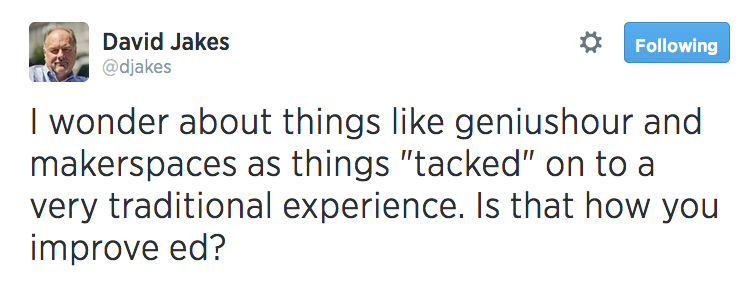
In a Tweet [10:18 AM – 16 Jul 2014], Digital Strategist and Designer David Jakes noted the following:

Screen Shot 2014-07-27 at 5.19.30 PM

So, yes. There is a caution. As the use of space and time is redesigned, we must make certain that traditional, industrial systems of learning not, as David observed, ”tack on” approaches, such as a Makerspace, Genius Hour, and project-based learning, without deep and thoughtful changes in TWTHABD (The Way Things Have Always Been Done).

How has the use of space and time in your learning organization prompted deep change? How did you overcome TWTHABD? Does your learning organization support learning around campfires, watering holds, and caves? How has your learning organization overcome “tacking on” to the traditional?

Please share your story.

Running the Digital River of Learning with You,
Emily


Book “The Alliance” and Lessons for Learning Organzations

Personal branding and Tours of Duty? Can learning organizations learn lessons from the book The Alliance: Managing Talent in the Networked Age, which calls for a bold, new blueprint of conducting business?

————-

We realize that lifetime employment in one organization is a thing of the past, especially considering the average U. S. worker median tenure in a current job to be 4.4 years, a trend which is perhaps silently influenced by the invisible “second economy.”

But, whatScreen Shot 2014-07-20 at 2.23.39 PM would happen in learning organizations if we capitalize on a bold, new blueprint of conducting business? Imagine the shift of hierarchical power play giving way to Tours of Duty, networking, and branding based on the mutual benefit of employer and employee? Those are a few founding principles found in the book The Alliance: Managing Talent in the Networked Age by Reid Hoffman, co-founder and chairman of LInkedin, Ben Casnocha, entrepreneur and author, and Chris Yeh, writer and investor.

While organizations cannot innovate if everyone acts as a free agent, the authors contend there is another pattern to growth (Check out their slideshow here.): “Stop thinking of employees as families or free agents” but, rather, regard them as “allies on a Tour of Duty.” The relationship between employee and employer is based on how each can add value to the other, thus, building trust. In this symbiotic relationship, the individual, while building personal brand, focuses on the organization’s success, while the organization increases the individual’s market value.

While the authors admit that the phrase “Tour of Duty” may have military implications and it isn’t a perfect analogy, there is a shared characteristic: “honorably accomplishing a specific, finite mission…with a realistic time horizon.”

Because roles and responsibilities vary, the authors outline three Tours of Duty: Rotational; Foundational; and Transformational. (For more information on the Tours of Duty, click here.) “The tour of duty approach relieves the pressure on you [organization or business] and your employees alike because it builds trust incrementally. Everyone commits in smaller steps and the relationship deepens as each side proves itself.”

The agreement between employee and employer within each Tour of Duty sets out specific growth goals for each. One example: “Over the next 18 months you will develop excellent negotiation skills.”  (Avoiding vagueness, such as gaining “valuable experience,” is key.)

But, what is one important turnkey in this model? The authors acknowledge the benefit of honest conversation and ask a potential employee: What do you want to do once you leave employment here?

There. The elephant in the room is acknowledged and provides the basis for building the symbiotic relationship of trust and success for both parties through Tours of Duty, building value of the organization and the independent individual.

And, even when an employee leaves the organization, the value continues as networks and “know how” remain within reach of the organization, which is able to tap into the web of connections it helped the individual create. (The alumni always stay in touch.)

Wow. I wonder how this upfront frankness about career goals and schools helping their employees grow to transform an organization would pan out. While there are numerous reasons teachers leave the classroom, would these honest conversations help stem the tide of 38% of teachers quitting because of dissatisfaction with administration or the 14% who leave after one year? Are industrial-style schools and slow-moving bureaucracies ready for this truthful conversation with themselves and others, including teachers, students, and parents?

There are some transformational movements taking hold, such as the Center for Teaching Quality’s work on building a new brand of teacher leadership through teacherpreneurs, and Connected Educators Month, to strengthen teacher learning networks and the connections the authors believe valuable. But, wouldn’t it be worthwhile to incubate ideas using this new approach to acknowledge and nurture talent in the networked age? Aren’t there implications not only for teachers but students as well?

I’m game for a discussion. Are you? Interested in a book study? Let’s connect! 

Running the Digital River of Learning with You,

Emily
Sylvia Martinez: Maker Movement in Schools

Pay attention as the Maker Movement brings authentic learning to the classroom.

Here, Sylvia Martinez, co-author of Invent to Learn and long dedicated to student-centered, authentic learning, discusses the Maker Movement and its application in schools.


What are you undertaking in your school with the Maker Movement? How are you rearranging time and space in your school to undertake authentic learning in a Maker Space?

Always Learning from Librarians (or is it Databrarians?)

I always learn from librarians: masters of organization, jugglers of information, and searchers of the new.

As noted in the October 17, 2013 Library Journal, the Databrarian is emerging, expanding the traditional role to include new titles and responsibilities such as emerging technologies specialist, user experience designer, digital content management, digital learning librarian, and social media manager.

There is no doubt that databriarins were in full swing at the International Society for Technology in Education (ISTE) this year at the Digital Age Library Playground. (Presenter email addresses and Twitter names are listed! So, you can reach out to them, as I have been doing.)

Sessions ranged from flipping and coding to creating Makerspaces and generating QR Codes; these databriarians were a whirl of action and learning.

The session GeniusCon asked a question of students: If you could change one thing about your school, what would *YOU* do?

Co-founders of GeniusCon Matthew Winner (@MatthewWinner) and Sherry Gick (@libraryfanatic) presented on “how kids from K to college shared their big ideas and how their genius is changing the world.” Matthew and Sherry shared their GeniusCon story – “an event in which students from around the world shared their big ideas to affect social change,” according to The Digital Shift. Wow! More schools should be doing this!

Learn more about GeniusCon in the School Library Journal article With “GeniusCon” Project, Students Connect and Problem Solve and follow their hashtag #geniuscon on Twitter.

What have you learned from librarians? Do you have a databrarian in your school?

The Disaggregation of Education (Beyond Disruption)

Revisiting My Two-Year Old Post: The Disaggregation of Education (Beyond Disruption) It rang true then and even more so today.

ehvickery's avatarRunning the Digital River of Learning

We have just crossed – in the past few months – the cusp of The Disaggregation of Education. Even though evolving, the working definition of the disaggregation of education is, after disruption, the education market breaks into smaller pieces. And, the smaller pieces that meet a changing market demand will be the successful ones, impacting all education venues, including higher education. As part of this disaggregation of education, higher education as we  know it just died. While schools of higher education play a role in the immediate future in providing teacher preparation, that will change..

Currently, the change is evidenced by the following:

View original post 473 more words

Badges to Micro-credentials

In the 2012 New York Times article Show Me Your Badge, Kevin Carey, director of the education policy program at the New America Foundation, outlined the emergence of digital badges and their role in recognizing skills and accomplishments beyond college degrees and certifications.

This year the Badges Alliance was launched at the Summit to Reconnect Learning. The Open Badges Alliance is “…Built upon the groundbreaking Open Badges work initiated by Mozilla and the MacArthur Foundation, and framed on a constellation model of Working Groups, the members of the Badge Alliance aim to foster and grow the open badges ecosystem in an intelligent, distributed, and sustainable way.” (I recently joined the Badge Alliance and look forward to participating in this groundbreaking work.)

But, what is the impact on K12 educators? Leave it to the forward-thinking folks at Digital Promise to take the lead in micro-credentials. Similar to Open Badges, the micro-credential provides rigor and is based on competencies as teachers build personalized learning portfolios of artifacts and reflections, providing “market worth” of mastery learning and accomplishments.

Last April, the Center for Teaching Quality invited me and other teacher leaders to submit work to Digital Promise in early rounds of discussion outlining micro-credentials. Renee Moore,  in Mississippi, and I, in Florida, partnered on our submission of a collaborative study of Letter from Birmingham Jail that she and I undertook with our students last year. (I learned quite a bit during the submission process, including providing more focus on student reflections during and after learning.)

At the International Society for Technology in Education conference in Atlanta earlier this month, Digital Promise officially opened up applications for its 2014 summer micro-credentialing pilot. According to Digital Promise, “Once earned, teachers can display their micro-credentials as digital badges. Each digital badge is embedded with metadata that identifies who issued the micro-credential, the date it was earned, and the artifacts submitted to earn it.”

Does this emerging professional development strategy appeal to you? Are you interested in earning micro-credentials?

#ISTE2014 Takeaway Two: Use of Time and Space

Energy. Ideas. Flexibility. Openness. Learning. Sharing. These are only a few words to capture the International Society for Technology in Education (ISTE) conference experience. It is important to note that the focus of #ISTE2014 was not on technology, digital tools, and gadgets but on the larger picture of relevant education topics – opening opportunities for students to learn without the restrictions of straight rows of desks. This is the second in a series of posts on #ISTE2014 takeaways.

For schools to become (or remain) relevant to today’s learning, the use of time (schedules) and space (classrooms, media centers, hallways, lunchrooms, grounds) must be viewed with a different lens, a fresh perspective. And, so it was at #ISTE2014 as reflected in this roundup of sessions provided by Sylvia Martinez of how space is morphing to fit the needs of collaborative pedagogy and student-centered curricula – think Maker Spaces and Learning Commons. For example, take Revere High School in Massachusetts; the 1:1 iPad school adopted flipped learning and revamped library space for a Learning Commons, complete with a Genius Bar, where students earn internship credits for helping others.

While an advocate for collaborative learning spaces for some time, I continue to learn how schools are using “space and time” in new ways for interdisciplinary applications. Check out Bob Pearlman’s examples of innovation labs, maker spaces, and learning commons, along with fab labs, weCreate, and other redefining-learning efforts. These examples, including revamped media centers and classrooms, speak to the collapse of the traditional, industrial age use of time and space in providing a more visionary and relevant curriculum supporting student empowerment.

  1. Shattuck-St. Mary’s School weCREATE Center, Faribault, MN
  2. Innovation Lab @Ross School, East Hampton, NY
  3. The Nueva School – Innovation Lab, Hillsborough, CA
  4. Quest Academy Innovation Lab, Palatine, IL
  5. Cushing Academy Innovation Lab, Ashburnham, MA
  6. Mount Vernon Presbyterian School, Atlanta, GA
  7. The Innovation Lab of Newton Public Schools, Newton, MA
  8. Thompson School District Innovation Lab, Loveland, CO
  9. Da Vinci High School Innovation Lab, Los Angeles, CA
  10. Mary Institute and Saint Louis Country Day School (MICDS) STEM Center, St. Louis, MO
  11. MC² STEM High School FABLAB, Cleveland, Ohio
  12. Westtown Science Center, Westtown, PA
  13. The Idea Lab @ Gunn Library, Gunn High School, Palo Alto, CA

Look for further posts on examining the importance of redesigning a school’s use of time and space. Until then, what are you doing in your schools to revamp time and space for learning?

#ISTE2014 Takeaway One: Maker Movement

Energy. Ideas. Flexibility. Openness. Learning. Sharing. These are only a few words to capture the International Society for Technology in Education (ISTE) conference experience. It is important to note that the focus of #ISTE2014 was not on technology, digital tools, and gadgets but on the larger picture of relevant education topics – opening opportunities for students to learn without the restrictions of straight rows of desks. This is the first in a series of posts on #ISTE2014 takeaways.

Maker Movement

I’ve been keeping an eye on the Maker Movement over the past few years, and #ISTE2014 had a fair share of sessions on the topic. This roundup, provided by Sylvia Martinez, reflects how the Maker Movement was showcased throughout #ISTE2014, including Gary Stager’s session Invent to Learn: Making, Tinkering, and Engineering in the Classroom. The room was packed, but I made it in to witness Gary’s energetic and passionate session to put kids back into the center of learning by “making.” He made the case of Schooling vs. Making and showcased Sylvia’s Super-Awesome Maker Show. Gary’s notes can be found here.

I look forward to reading Gary and Sylvia’s book Invent to Learn, which is on my desk, along with David and Norma Thornburg and Sara Armstrong’s book 3D Printing in the Classroom.

Meanwhile, you can find a wonderful book review of Invent to Learn by Kevin Hodgson at Middleweb.com.

For further resources, checkout ASCD’s Project Ideas, Videos, and Other “Making” Resources from the June 2014 Education Update feature, “If You Build It: Thinking with the Maker Mind-Set.” 

Are you undertaking a Maker Faire or undertaking the “Maker Movement” in your school or community? Please share!

Emergent Leadership for Learning Organizations

The conversation over at EdTechWomen on leadership sparked a reflection as to what characteristics are needed to be a leader, not a manager.

During my career as an educator, I have led professional development with a keen eye on servant leadership. Teacher voice and input is critical and often overlooked in traditional hierarchical organizations, which must give way for DIY learning and the push of market demand in an ever-increasing learning landscape of choice. In interviews with Tom Friedman and Adam Bryant, Laszlo Bock, the senior vice president of people operations for Google, noted several characteristics that are very important in emergent leadership, which is critical in the hyper-connected, morphing world of learning:

Stepping In & Out of Leadership
Bock observes, “’What we [Google] care about is, when faced with a problem and you’re a member of a team, do you, at the appropriate time, step in and lead. And just as critically, do you step back and stop leading, do you let someone else?’” The ability to step in and lead but also step back, letting others lead is key for we tap into the energies and thinking of others to tackle a problem, design new programs, or re-imagine what is possible.

Humility: Relinquishing Power
Bock believes humility is essential for learning by relinquishing power “’to step back and embrace the better ideas of others.’”

Consistency, Fairness, Predictability
Another key characteristic Bock cites is consistency: “’We found that, for leaders, it’s important that people know you are consistent and fair in how you think about making decisions and that there’s an element of predictability. If a leader is consistent, people on their teams experience tremendous freedom, because then they know that within certain parameters, they can do whatever they want. If your manager is all over the place, you’re never going to know what you can do, and you’re going to experience it as very restrictive.’” Being a leader is quite different than being a manager, and consistency, fairness, and predictability in leadership is an imperative to avoid the restrictive environment Bock mentions and critical for shepherding creativity and freedom to develop effective “moving forward” strategies for any organization, including schools. If team members are not sure of a leader’s (or manager’s) behavior on any given day, “moving forward” strategies are either stifled or never realized out of fear of backlash.

What do you think of these emergent leadership characteristics? Are learning organizations ready for them? Does your organization embrace emergent leadership?

EdTechWomen: What is Leadership?

EdTechWomen (ETW) has announced their speakers for the #ISTE2014 dinner event, an exciting lineup: Sheryl Nussbaum-Beach, CEO of Powerful Learning Practice, and Matt Wallaert, behavioral scientist at Microsoft. In preparation for the event, ETW has asked attendees to share their thoughts on leadership.

Their statements are powerful and provide reflection on our beliefs about leadership.

Making Decisions, Providing Guidance

Theresa Quilici, Library Media Specialist at Rome Middle School – “Good leaders are passionate, energetic, and knowledgeable of current trends. They listen to stakeholders, view issues from multiple sides, and then make decisions that guide their teams toward success.”

Providing and Accepting Timely Feedback

Martha Fairley, Director of Instructional Technology and Connect Online Learning at Eagle’s Landing Christian Academy – “Good leaders give timely feedback and create an atmosphere that welcomes feedback. Flexibility accompanied by the ability to regroup and move forward is a must of every good leader.”

No Dictating, Taking People Down, or Fear Tactics

Wendy Drexler, Chief Innovation Officer of ISTE – “A good leader listens carefully, respects the ideas of others, and uses her experience to build others up rather than dictate or take people down. I judge my success by the success of those I touch. Of course, integrity, courage, calculated risk taking, and dedication also go a long way.”

Elana Leoni, Director of Social Media Strategy and Marketing at Edutopia – “The best leaders are those that inspire and motivate without fear tactics.”

On Motivation and Inspiration

Andrea Anderson, Manager of Integration and Customer Support at Atomic Learning – “A good leader does not simply take a group forward but helps to blaze the path by inspiration and motivation to help others achieve greatness.”

Anyone Can Be a Leader (title ≠ leadership)

Jill Thompson, Personalized Learning Program Manager in Charlotte Mecklenburg Schools – “My motto is ‘You don’t have to be in a leadership position, to be a leader.’ Leadership to me is influencing others to take on challenges and help them produce solutions.”

Elana Leoni, Director of Social Media Strategy and Marketing at Edutopia – “Leadership is a choice — not a rank. The best leaders are those that inspire and motivate without fear tactics.”

Beyond “The Normal” – Beyond the Comfortable

Michelle Cordy, Teacher and Applied Research at the Thames Valley District School Board – “Leadership is having the courage to say, think and do things that are outside the realm of what is happening and what is normal. It’s about acting a little differently to try and dent the world a little. A good leader makes their actions and rationale visible to others and invites others on the journey.

I look forward to learning more from others at the #ISTE2014 EdTechWomen event. What is leadership to you? How do you define leadership?